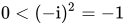
Here we will formally define the complex numbers  and prove that they form a field. First of all we will clarify what the addition and multiplication of complex numbers should look like.
Derivation of the tuple notation
Complex numbers have the form  , where
  are real numbers and the imaginary unit
  satisfies the equation
  . However, we lack a mathematical definition for this new form of a number. So we will derive now a reasonable and precise definition.
A complex number is described by the two real numbers  and
and  . Furthermore, complex numbers can be represented as points in a plane. is the
  -coordinate of the point and the imaginary part is the
  -coordinate:
Now points within the plane can be described as tuples  of the set
  . So we can assign to a tuple in
  the complex number . So we identify
 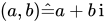 , which provides a one-to-one identification of the complex set of numbers with the set .
The tuple is a precisely defined mathematical concept, we can use it for the formal definition of the complex numbers. To this we say that complex numbers are in fact tuples within a special notation and that allow for a multiplication (to be defined later).
Deriving computational rules
It would be nice to calculate with complex numbers like with real numbers, by adding and multiplying them. Let us first consider the addition of two complex numbers and  . The result should again be a complex number, i.e. of the form
  . For this we add the two complex numbers, arrange the summands and factor out:
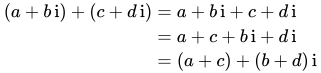
The result is again of the form . The real and the imaginary parts are added up. For the formal definition of the addition we use the tuple notation in , with identification 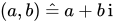 . With this we translate the above calculation into the tuple notation:

We see that summing nothing else than a component-wise addition in . This is exactly the vector addition in the plane . The multiplication of complex numbers is more complicated. We consider the product of two complex numbers and and multiply out the product:
![{\displaystyle {\begin{aligned}&(a+b\,\mathrm {i} )\cdot (c+d\,\mathrm {i} )\\[0.3em]&{\color {OliveGreen}\left\downarrow \ {\text{multiply out}}\right.}\\[0.3em]&=a\cdot c+a\cdot d\,\mathrm {i} +b\,\mathrm {i} \cdot c+b\,\mathrm {i} \cdot d\,\mathrm {i} \\[0.3em]&=a\cdot c+(a\cdot d)\,\mathrm {i} +(b\cdot c)\,\mathrm {i} +(b\cdot d)\,\mathrm {i} ^{2}\\[0.3em]&{\color {OliveGreen}\left\downarrow \ \mathrm {i} ^{2}=-1\right.}\\[0.3em]&=a\cdot c+(a\cdot d)\,\mathrm {i} +(b\cdot c)\,\mathrm {i} -(b\cdot d)\\[0.3em]&{\color {OliveGreen}\left\downarrow \ {\text{re-arrange summands}}\right.}\\[0.3em]&=(a\cdot c-b\cdot d)+(a\cdot d+b\cdot c)\,\mathrm {i} \end{aligned}}}](./_assets_/eb734a37dd21ce173a46342d1cc64c92/5f6487133dafb7f52484092f770c515f1937656d.svg)
Translated in the tuple-notation, we have:

Definition of complex numbers
The complex numbers are defined as tuples in with the appropriate addition and multiplication.
Definition (Set of complex numbers )
We define the set of complex numbers as the set  together with two mappings "addition" and "multiplication". Complex numbers are thus tuples , where and are real numbers. Addition and multiplication are defined by

Definition of real and imaginary part
A complex number  , can be described as a point in the plane. It is uniquely defined by its coordinates and . These coordinates have special names. is called real part and imaginary part of the complex number.
We can calculate with complex numbers as with real numbers. The addition corresponds to the vector addition in . Thus it inherits all properties of the addition in a vector space and fulfils for example the associative law  and the commutative law
  . The multiplication in the complex numbers has similar properties as the multiplication in the real numbers.
Like in the real numbers we can form fractions of the form  in . This requires inverting a complex number to
  . The reciprocal number should satisfy the equation
  . So we need to choose
  such that
  holds. We will see that this system of equations is uniquely solvable for all
  .
.
Altogether the addition and the multiplication fulfil the so-called Körperaxiome, as it does for the real numbers. Thus, calculations in work with a similar structure compared to those within the real numbers.
Theorem
Let  be the set of complex numbers with addition and multiplication:
This set satisfies the field axioms.
How to get to the proof?
We now want to check the validity of the field axioms in the complex numbers one after the other. For this we will start from the definitions of addition and multiplication in and use the properties of the real numbers.
Let us consider, for example, the commutativity of multiplication. To prove this, we have to prove the following equation:

What transformation steps do we have to take to get from the left side of the term om the right? First, it is helpful to apply the definition of multiplication in the complex numbers, i.e.  and
and  . Thus we obtain

This way, most of the proof is already done. What remains to be shown is the equality  , which we obtain directly from the properties of
  : Since
  are from the field of real numbers, we know, due to the commutativity of the multiplication, that
  and
and  holds. Hence we have proved the commutativity of multiplication in complex numbers. In a very similar way the other field axioms for complex numbers can be shown.
Besides the associativity and commutativity of addition and multiplication we have to prove the existence of the neutral and inverse element of addition and multiplication in . We do this by constructing such an element and showing by explicit calculation that it has the properties required in the field axioms.
The neutral element of addition is not difficult to find: We suspect the origin of the complex plane to take this role, which corresponds to the zero in the complex number plane or a zero vector. The point  should therefore be the complex zero. Also from the definition of addition it is easy to see that
 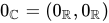 must be valid, so that
  is fulfilled.
We can easily determine the additive inverse of a complex number by determining the additive inverse of the two real numbers . We obtain  , which can be shown to be the the additive inverse of by explicit calculation.
Regarding the neutral element of the multiplication, we assume that, as with the neutral element of the addition, an analogy to the real numbers applies. On the real number line, 1 is the neutral element of the multiplication. In the complex plane this corresponds to the point with the coordinates  . And we can explicitly verify that
 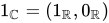 has the desired properties.
Now we still have to find the multiplicative inverse. This is somewhat more difficult than the additive inverse because multiplication is defined in a more complicated way than addition. For a given  with
with 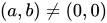 we search for a complex number
  with
with  . Here, is the "one" already found in the complex numbers.
What conditions must fulfil as the inverse of ? According to the definition of multiplication, . Thus  must apply. This requires 2 equations to be fulfilled:

This is a system of equations with two unknowns, namely  and
and  , and two equations. We can try to solve this system of equations, i.e. solve the equations for and . If you have 10 minutes (perhaps, it takes far less), take a pen and paper and try to solve the two equations for and .
We present here an elegant solution that does not require any case distinction due to division by zero. But it is not intuitive and few people would do the same on the first try. First we multiply the first equation with and the second with :
![{\displaystyle {\begin{aligned}{\begin{array}{rcr}ac-bd=1&\implies &a^{2}c-abd=a\\[0.3em]ad+bc=0&\implies &abd+b^{2}c=0\end{array}}\end{aligned}}}](./_assets_/eb734a37dd21ce173a46342d1cc64c92/9c883f970fbf725f1ea5f4f92b2425e94d112eba.svg)
We add both equations and obtain:
![{\displaystyle {\begin{aligned}{\begin{array}{rrl}&a^{2}c+0+b^{2}c&=a+0\\[0.3em]\implies &(a^{2}+b^{2})c&=a\\[0.3em]&&{\color {OliveGreen}\left\downarrow \ {\begin{array}{l}a^{2}+b^{2}\neq 0,\\{\text{since }}(a,b)\neq (0,0)\end{array}}\right.}\\[0.3em]\implies &c&={\frac {a}{a^{2}+b^{2}}}\end{array}}\end{aligned}}}](./_assets_/eb734a37dd21ce173a46342d1cc64c92/70772b8853d337b8432324f4110fcccd51f2b04a.svg)
Now, we multiply the other way round, i.e. the first equation with and the second one with :
![{\displaystyle {\begin{aligned}{\begin{array}{rcr}ac-bd=1&\implies &abc-b^{2}d=b\\[0.3em]ad+bc=0&\implies &a^{2}d+abc=0\end{array}}\end{aligned}}}](./_assets_/eb734a37dd21ce173a46342d1cc64c92/d96d13e71586ee354f22ae96559b4864d7f9ba66.svg)
Subtracting the first equation from the second, we get:
![{\displaystyle {\begin{aligned}{\begin{array}{rrl}&a^{2}d+0+b^{2}d&=-b\\[0.3em]\implies &(a^{2}+b^{2})d&=-b\\[0.3em]&&{\color {OliveGreen}\left\downarrow \ {\begin{array}{l}a^{2}+b^{2}\neq 0,\\{\text{since }}(a,b)\neq (0,0)\end{array}}\right.}\\[0.3em]\implies &d&={\frac {-b}{a^{2}+b^{2}}}\end{array}}\end{aligned}}}](./_assets_/eb734a37dd21ce173a46342d1cc64c92/25b1dcdcdec411e5ce51607d7306bd21b5f8124a.svg)
So we found  as the inverse of . In the proof we willverify that indeed .
Proof
We must verify all field axioms. Let  be given arbitrarily.
Proof step: Associative law for addition
![{\displaystyle {\begin{aligned}(a,b)+{\bigg (}(c,d)+(e,f){\bigg )}&=(a,b)+(c+e,d+f)\\&=(a+(c+e),b+(d+f))\\&{\color {OliveGreen}\left\downarrow \ {\text{associative law in }}\mathbb {R} \right.}\\[0.3em]&=((a+c)+e,(b+d)+f)\\&=(a+c,b+d)+(e,f)\\&={\bigg (}(a,b)+(c,d){\bigg )}+(e,f)\end{aligned}}}](./_assets_/eb734a37dd21ce173a46342d1cc64c92/b8e431a0649277fcc69d93990a19666d645bd9c9.svg)
Proof step: Commutative law for addition
![{\displaystyle {\begin{aligned}(a,b)+(c,d)&=(a+c,b+d)\\&{\color {OliveGreen}\left\downarrow \ {\text{commutative law in }}\mathbb {R} \right.}\\[0.3em]&=(c+a,d+b)\\&=(c,d)+(a,b)\end{aligned}}}](./_assets_/eb734a37dd21ce173a46342d1cc64c92/4fdbe452477a3d66a9c5fef12bfe9981188b60c6.svg)
Proof step: Existence of a zero elemen
The zero element in is given by , since
![{\displaystyle {\begin{aligned}(0,0)+(a,b)&=(a+0,b+0)\\&{\color {OliveGreen}\left\downarrow \ {\text{definition of }}0{\text{ in }}\mathbb {R} \right.}\\[0.3em]&=(a,b)\end{aligned}}}](./_assets_/eb734a37dd21ce173a46342d1cc64c92/3ff53b61f8d08093cf8a4a6b6f0a0c29e4581c83.svg)
Proof step: Existence of the additive inverse
In there is , since
![{\displaystyle {\begin{aligned}(a,b)+(-a,-b)&=(a-a,b-b)\\&{\color {OliveGreen}\left\downarrow \ {\text{additive inverse in }}\mathbb {R} \right.}\\[0.3em]&=(0,0)\end{aligned}}}](./_assets_/eb734a37dd21ce173a46342d1cc64c92/45240f40e9b553f0103db47b720b89429cb3a60d.svg)
Proof step: Associative law for multiplikation
![{\displaystyle {\begin{aligned}(a,b)\cdot {\bigg (}(c,d)\cdot (e,f){\bigg )}&=(a,b)\cdot (ce-df,cf+ed)\\&=(a\cdot (ce-df)-b\cdot (cf+ed),a\cdot (cf+ed)+b\cdot (ce-df))\\&{\color {OliveGreen}\left\downarrow \ {\text{distributive law in }}\mathbb {R} \right.}\\[0.3em]&=(ace-adf-bcf-bed,acf+aed+bce-bdf)\\&=((ac-bd)\cdot e-(ad+bc)\cdot f,(ac-bd)\cdot f+(ad+bc)\cdot e)\\&{\color {OliveGreen}\left\downarrow \ {\text{distributive law in }}\mathbb {R} \right.}\\[0.3em]&=(ac-bd,ad+bc)\cdot (e,f)\\&={\bigg (}(a,b)\cdot (c,d){\bigg )}\cdot (e,f)\end{aligned}}}](./_assets_/eb734a37dd21ce173a46342d1cc64c92/87dcf126f5a3dd5d62ad3fdcc197598007565953.svg)
Proof step: Commutative law for multiplikation
![{\displaystyle {\begin{aligned}(a,b)\cdot (c,d)&=(ac-bd,ad+bc)\\&{\color {OliveGreen}\left\downarrow \ {\text{commutative law in }}\mathbb {R} \right.}\\[0.3em]&=(ca-db,da+cb)\\&=(c,d)\cdot (a,b)\end{aligned}}}](./_assets_/eb734a37dd21ce173a46342d1cc64c92/1cb5bd392f9919343e67a0afd1b1815f9128e170.svg)
Proof step: Existence of a unit element
The unit element in is : there is 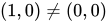 and
and
![{\displaystyle {\begin{aligned}(1,0)\cdot (a,b)&=(1\cdot a-0\cdot b,1\cdot b+0\cdot a)\\&{\color {OliveGreen}\left\downarrow \ {\text{properties of }}0{\text{ and }}1{\text{ in }}\mathbb {R} \right.}\\[0.3em]&=(a-0,b+0)\\&=(a,b)\end{aligned}}}](./_assets_/eb734a37dd21ce173a46342d1cc64c92/f8833cfcabc979934d573d3be07c2828e38bf25e.svg)
Proof step: Existence of the multiplicative inverse
Let a complex number with . The inverse of this number is  . This number is well defined, since and hence
  . And there is
![{\displaystyle {\begin{aligned}(a,b)\cdot (a,b)^{-1}&=(a,b)\cdot \left({\frac {a}{a^{2}+b^{2}}},{\frac {-b}{a^{2}+b^{2}}}\right)\\[0.3em]&=\left(a\cdot {\frac {a}{a^{2}+b^{2}}}-b\cdot {\frac {-b}{a^{2}+b^{2}}},a\cdot {\frac {-b}{a^{2}+b^{2}}}+b\cdot {\frac {a}{a^{2}+b^{2}}}\right)\\[0.3em]&=\left({\frac {aa+bb}{a^{2}+b^{2}}},{\frac {-ab+ba}{a^{2}+b^{2}}}\right)\\[0.3em]&=\left({\frac {a^{2}+b^{2}}{a^{2}+b^{2}}},{\frac {0}{a^{2}+b^{2}}}\right)\\[0.3em]&{\color {OliveGreen}\left\downarrow \ {\text{multiplicative inverse of }}a^{2}+b^{2}{\text{ in }}\mathbb {R} \right.}\\[0.3em]&=(1,0)\end{aligned}}}](./_assets_/eb734a37dd21ce173a46342d1cc64c92/6a267ff0b2ea4ed7ee9036a48beec03c3a1ca460.svg)
Proof step: Distributive law
![{\displaystyle {\begin{aligned}(a,b)\cdot {\bigg (}(c,d)+(e,f){\bigg )}&=(a,b)\cdot (c+e,d+f)\\&=(a\cdot (c+e)-b\cdot (d+f),a\cdot (d+f)+b\cdot (c+e))\\&{\color {OliveGreen}\left\downarrow \ {\text{distributive law in }}\mathbb {R} \right.}\\[0.3em]&=(ac+ae-bd-bf,ad+af+bc+be)\\&=(ac-bd,ad+bc)+(ae-bf,af+be)\\&=(a,b)\cdot (c,d)+(a,b)\cdot (e,f)\end{aligned}}}](./_assets_/eb734a37dd21ce173a46342d1cc64c92/5a86aa55afb9083b9e019e7c70724c234f4e281a.svg)
as a sub-field of
We identify the complex numbers with the plane . Here the axis lying in the complex plane is the real number line. So it makes sense that the real numbers are a subset of the complex numbers .
We also know that both and are fields. So should be a sub-field of . In order to verify this, we have to show more than that is a subset of . We must also prove that the addition and multiplication of real numbers in again leads to real numbers. Mathematically, two statements have to be shown: is a subset of and the arithmetic operations preserve the real numbers in .
The first statement is easily confirmed. Strictly speaking, is not subset of , since  is a set of tuples and just a set of single. So the elements of and of are different.
However, we can identify the real numbers with a subset of the complex numbers, which behaves similar to . To find this subset, we use the visualization of the complex numbers in the plane. The subset we are looking for is the real axis in the complex plane. A complex number 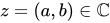 lies on this axis exactly when its imaginary part is zero, i.e.
  . Thus the real line is identified with the set
  .
.
Now, a quick mathematical investigation of the identification of  with the real numbers follows. Intuitively, there is nothing to do: the real line looks like the real axis within the complex plane. Mathematically, there is still some work to be done: we need a one-to-one relationship (bijective mapping) of to . Or we define an injective mapping
  (called embedding) with
  . Then
  bijectively maps the real numbers to .
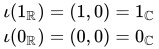
And we need that has the same structure as the real numbers. Our embedding map should preserve the structure of in the image. This means, sums in should be mapped from to sums in and the same with products. And the neutral elements  and
and  shall be mapped from the real numbers to the corresponding neutral elements in the complex numbers. (A mapping with such properties is also called field homomorphism).
How should we choose ? Let us look again at our visualization of the complex plane. We want to map the real number line to the real axis . The easiest way to do this is to just embed the number line into the two-dimensional plane. In other words, map a real number  to
to  :
:
Definition (Embedding of the real into the complex numbers)
The function with the assignment rule  is an embedding of the real numbers in the complex numbers.
It remains to be shown that our picture fulfils the characteristics of an injective field homomorphism. Such an injective body homohorphism is also called field monomorphism:
Theorem (Embedding of the real numbers is a field homomorphism)
The embedding with is a field monomorphism (= injective field homomorphism)
How to get to the proof? (Embedding of the real numbers is a field homomorphism)
To show that any function  between two fields
  and
and  is a field homomorphism, the following properties must be verified:
We have to verify these properties for . To do this, we first translate the properties to be verified into the case of . For example, the formula  becomes
![{\displaystyle {\begin{aligned}{\color {Thistle}f}(a\cdot _{\color {RedOrange}L}b)&={\color {Thistle}f}(a)\cdot _{\color {Blue}K}{\color {Thistle}f}(b)\\[0.3em]&\downarrow \\[0.3em]{\color {Thistle}\iota }(a\cdot _{\color {RedOrange}\mathbb {R} }b)&={\color {Thistle}\iota }(a)\cdot _{\color {Blue}\mathbb {C} }{\color {Thistle}\iota }(b)\\[0.3em]\end{aligned}}}](./_assets_/eb734a37dd21ce173a46342d1cc64c92/026a5022b2eef51a3cb1dce25acb31cd4a48b1d7.svg)
So we have to prove the equation  . Here we can first use the definition of . With this the following chain of equations can be shown:

By explicitly calculating  this chain of equations can be proven. The same can be done for the other properties. The proof of injectivity is done by a similar procedure.
Proof (Embedding of the real numbers is a field homomorphism)
Let  . Further, as defined above,
  is the neutral element of multiplication in , and
  is the neutral element of addition in . There is:
Proof step: preserves neutral elements
Proof step: 

Proof step:
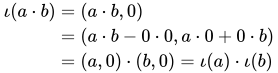
Proof step: is injective
Let with  . Consequently
  , so
, so 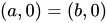 . This means,
  and our map is injective.
Thus the map is an injective field homomorphism , i.e. a field homomorphism.
Due to the properties of a field monomorphism, the structure of a field is preserved in the image of the embedding. Simply put, the image of the field monomorphism fulfils the field axioms and thus defines a field again. Since the image of the embedding is a subset of the field of complex numbers, we can regard the image  as a sub-field of . Furthermore, the image
  gives a field isomorphism, i.e. a bijective field homomorphism between and
  . This justifies the notion
  and we view from now on all real numbers as equal to the complex number
  .
.
Definition of the notation
We would like to write a complex number as . According to our definition with  , this number is the tuple . To simplify calculations, we would like to introduce the notation without the tuple. For this we have to define mathematically. Since lies in the complex plane on the axis at coordinate , we choose
  :
:
Definition (Imaginary unit)
We set , which allows use to use this letter as a complex number.
In the beginning we looked for the solution of the equation  and with we found one of these solutions. We can verify that for
  by explicit computation:
![{\displaystyle {\begin{aligned}\mathrm {i} ^{2}&=\mathrm {i} \cdot \mathrm {i} =(0,1)\cdot (0,1)\\[0.3em]&=(0\cdot 0-1\cdot 1,0\cdot 1+1\cdot 0)\\[0.3em]&=(-1,0)=\iota (-1)=-1\end{aligned}}}](./_assets_/eb734a37dd21ce173a46342d1cc64c92/a38295ccb05ec5c1cc5a433df857b88facbba8e5.svg)
Here, we use the embedding of the real numbers in and the notation  for . So there indeed is . Now we show that the notation for indeed makes sense. Using
  for
for  we show
 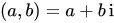 . Thanks to this proof, we can then calculate with the complex number as if it was a sum:
Theorem
For all there is 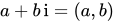 .
.
Proof
Let . Then
![{\displaystyle {\begin{aligned}(a,b)&=(a,0)+(0,b)\\[0.5em]&{\color {OliveGreen}\left\downarrow \ {\begin{aligned}&(b,0)\cdot (0,1)\\=&(b\cdot 0-0\cdot 1,b\cdot 1+0\cdot 0)\\=&(0,b)\end{aligned}}\right.}\\[0.5em]&=(a,0)+(b,0)\cdot (0,1)\\&=a+b\cdot (0,1)=a+b\,\mathrm {i} \end{aligned}}}](./_assets_/eb734a37dd21ce173a46342d1cc64c92/b0c86fff5134a9405e5758f21873e1f462dbf96a.svg)
is not an ordered field
It would be nice to have an ordering of complex numbers, that means a larger/smaller relation for complex numbers. Let us consider the numbers and . We notice that they lie on the unit circle. This is the set of all points which have the distance to zero:
Is now  ,
,  or
or  ? At first this case seems to be ambiguous, because both numbers have the same absolute value. What about and
  ? The number is further away from zero than the number . Is
  then also valid? Can the product of a negative number with the imaginary unit really be greater than a positive number?
From these small examples we can already see that establishing an ordering of complex numbers is difficult. In fact this is not possible. The following theorem proves this:
Theorem
There is no ordering of the complex numbers that maintains the order of the real numbers.
is algebraically closed
With we constructed a field in which the equation is solvable, so the polynomial  has a zero. In the complex numbers we even have that every polynomial (with coefficients in ) of degree greater or equal to has at least one zero. This excludes only constant polynomials, which of course (except the zero polynomial) have no zeros. This property is not valid in the real numbers: for instance, has no real zeros.
This property of complex numbers is called algebraic closure and is treated in algebra. The algebraic closure of is proved in a theorem with the majestic name Fundamental Theorem of Algebra.
Exercises