The image of a linear map  is the set of all vectors in
  that are "hit by
  ". This set of vectors forms a subspace of and can be used to make the linear map surjective.
Derivation
We consider a linear map  between two
  -vector spaces
  and . A vector
  is transformed by into a vector
  . The mapping does not necessarily hit all elements from , because is not necessarily surjective. The mapped vectors
  form a subset
  . This set is called image of .
Since is linear, preserves the structure of the vector spaces and . Therefore, we conjecture that maps the vector space into a vector space. Consequently, the image of , i.e., the set 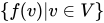 should be a subspace of . We will indeed prove this in a theorem below.
Definition
Hint
In the literature, the notation  is also often used instead of
  for the image of .
In the derivation we already considered that should be a subspace of . We now prove this as a theorem.
Image and surjectivity
We already know that a mapping is surjective if and only if the mapping "hits" all elements of . Formally, this means that is surjective if and only if  . Now if is a linear map, then is a subspace of . In particular, if is finite-dimensional, then is surjective exactly if
  .
.
Example
The identity  is a linear map. It is surjective, because every element
  has the preimage . Hence, we have
  and in particular
  .
.
The map  is also linear. Further, each element has a preimage, for example
 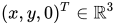 . Thus we have shown
  and thus, is surjective. In particular
 .
.
The embedding  is also linear, but not surjective. The vector
  is not contained in
  . Thus
  must hold. And indeed
  .
.
Sometimes it is useful to show the surjectivity of by proving  .
.
Example
We consider the linear map  and ask if is surjective. We want to answer the question by determining the dimension of and comparing it with
 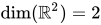 . To do this, we first look for linearly independent vectors in the image of .
The vectors
. To do this, we first look for linearly independent vectors in the image of .
The vectors  and
and  are linearly independent.
Therefore,
are linearly independent.
Therefore,  .
Now
.
Now  from which we get
  .
Thus, we obtain
.
Thus, we obtain  and is surjective.
The relationship between image and generating system
We have seen in the article on epimorphisms,
that a linear map preserves generators of if and only if it is surjective.
In this case, the image of each generator of generates the entire vector space . In particular, the image of each generator of generates the image of . The last statement holds also for non-surjective linear maps:
Proof (The image is the span of the images of a generating system)
We show the two inclusions.
Proof step: 
Let  .
Then there are
.
Then there are  ,
,  and coefficients
  , such that
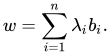
Since the  are in
  ,
there exist some
,
there exist some  with
with  for
for  .
Then, because of the linearity of , we have
.
Then, because of the linearity of , we have

Proof step: 
Let  .
Then there is a with
.
Then there is a with  .
Since
.
Since  is a generator of ,
there are an ,
is a generator of ,
there are an ,  and coefficients , such that
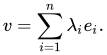
Now linearity of finally implies:
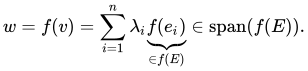
Image and linear system
Let  be an
be an  matrix and
  . The associated system of linear equations is
  . We can also interpret the matrix as a linear map
  . In particular, the image
  of
of  is a subset of
  .
.
If  , there is some
  such that
  . By definition of we have
  . Thus, the linear system of equations is solvable. Conversely, if is solvable, then there exists an with . For this
  , we now have . Thus .
So the image gives us a criterion for the solvability of systems of linear equations: A linear system of equations is solvable if and only if  lies in the image of . However, the criterion makes no statement about the uniqueness of solutions. For this, one can use the kernel.
Examples
We will now look at how to determine the image of a linear map.
Example
Let us consider the linear map

This is a projection to the  axis.
Intuitively, then, the image of should be the -axis, i.e.
axis.
Intuitively, then, the image of should be the -axis, i.e.
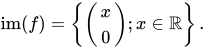
We now want to prove this:
If  , then there exists some
 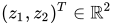 with
with  . So
. So  .
.
Conversely, because  every vector of the form
  has a preimage under . So every such vector lies in .
This proves the desired statement.
Example
Let be a field. We consider the linear map
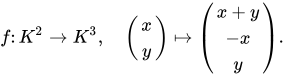
We want to determine the image of . To do this, we exploit the fact that  is a basis of
  , so in particular it is a generator. We have seen in the last section that then
  .
.
We can specify this space explicitly by calculating the span:
![{\displaystyle {\begin{aligned}\operatorname {im} (f)&=\operatorname {span} (f(e_{1}),f(e_{2}))\\[1em]&{\color {OliveGreen}\left\downarrow \ {\text{Insert definition of the span}}\right.}\\[1em]&=\left\{\lambda \cdot {\begin{pmatrix}1\\-1\\0\end{pmatrix}}+\mu \cdot {\begin{pmatrix}1\\0\\1\end{pmatrix}};\lambda ,\mu \in K\right\}\\[1em]&{\color {OliveGreen}\left\downarrow \ {\text{Add up}}\right.}\\[1em]&=\left\{{\begin{pmatrix}\lambda +\mu \\-\lambda \\\mu \end{pmatrix}};\lambda ,\mu \in K\right\}\\[1em]&{\color {OliveGreen}\left\downarrow \ {\text{ replace }}\lambda {\text{ by }}-x{\text{ and }}\mu {\text{ by }}y\right.}\\[1em]&=\left\{{\begin{pmatrix}y-x\\x\\y\end{pmatrix}};x,y\in K\right\}\end{aligned}}}](./_assets_/eb734a37dd21ce173a46342d1cc64c92/ab0c58e237eb193f5e379c83ed15c5274c8dab52.svg)
After considering two examples in finite-dimensional vector spaces, we can venture to an example with an infinite-dimensional vector space. We consider the same function in the examples for determining the kernel of a linear map.
Example
Our goal is to determine the image of the linear map of the derivative  of polynomials over
  . The set
  is a basis of
  . The derivative function
  is defined by
  for all
  .
.
We now want to know whether is surjective. To do this, we note that  holds for every
  . Thus every basis element of
 ![{\displaystyle \mathbb {R} [X]}](./_assets_/eb734a37dd21ce173a46342d1cc64c92/16d740527b0b7f949b4bf9c9ce004134bb490b68.svg) is hit. So
is hit. So ![{\displaystyle \operatorname {im} (f)\supseteq \operatorname {span} (1,X,X^{2},\dots )=\mathbb {R} [X]}](./_assets_/eb734a37dd21ce173a46342d1cc64c92/808141f530094c1a2beb6a0aecc13db46426a5fc.svg) , and is indeed surjective.
, and is indeed surjective.
When solving systems of linear equations, we will see many more examples. We will also learn a methodical way of solving for the determination of images.
To-Do:
link as soon as it is written.
Making linear maps "epic"
We now want to construct a surjective linear map from a given linear map . If we consider to be a mapping of sets, we already know how to accomplish this: We restrict the target set of to and get some restricted mapping  . Now, we just need to check that
  is linear. But this is clear because
  is a subspace of . So all we need to do to make surjective (i.e., an epi-morphism) is to restrict the objective of to .
This method also gives us an approach for making functions between other structures surjective: We need to check that the restriction on the image preserves the structure. For example, for a group homomorphism  we can show that
  is again a group and
  is again a group homomorphism.
Outlook: How surjective is a linear map? - The cokernel
In the article about the kernel we see that the kernel "stores" exactly that information which a linear map "eliminates". Further, is injective if and only if  and the kernel intuitively represents a "measure of the non-injectivity" of .
We now want to construct a similar measure of the surjectivity of . The image of is not sufficient for this purpose: For example, the images of  and
and  are isomorphic, but
  is surjective and
  is not. From the image alone, no conclusions can be drawn as of whether is surjective, because surjectivity also depends on the target space . To measure "non-surjectivity," on the other hand, we need a vector space that measures, which part of is not hit by .
The space contains the information, which vectors are hit by . The goal is to "remove this information" from . We have already realized this "removal of information" in the article on the factor space by taking the quotient space  . We call this space the cokernel of . It is indeed suitable for characterizing the non-surjectivity of , because is equal to the null space
  if and only if is surjective: A vector in that is not hit by yields a nontrivial element in and, conversely, a nontrivial element in yields an element in that is not hit by .
The kokernel even measures how non-surjective is exactly: if is larger, more vectors are not hit by . If is finite dimensional, we can measure the size of using the dimension. Thus,  is a number we can use to quantify how non-surjective is. However, unlike , this number does not allow us to reconstruct the exact vectors that are not hit by .
Exercises
Solution (Associating image spaces to figures)
First we look for the image of :
To find , we can apply a theorem from above: If is a generator of  , then
  holds. We take the standard basis
  as the generator of . Then

Now we apply to the standard basis
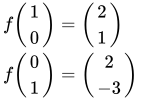
The vectors  generate the image of . Moreover, they are linearly independent and thus a basis of .
Therefore . So
generate the image of . Moreover, they are linearly independent and thus a basis of .
Therefore . So  .
.
Next, we want to find the image of . However, it is also possible to compute the image  directly by definition, which we will demonstrate here.
![{\displaystyle {\begin{aligned}\operatorname {im} (g)&=\left\{g{\begin{pmatrix}x\\y\end{pmatrix}}\mid {\begin{pmatrix}x\\y\end{pmatrix}}\in \mathbb {R} ^{2}\right\}\\&=\left\{{\begin{pmatrix}x\\2x\end{pmatrix}}\mid {\begin{pmatrix}x\\y\end{pmatrix}}\in \mathbb {R} ^{2}\right\}\\&=\left\{x{\begin{pmatrix}1\\2\end{pmatrix}}\mid {\begin{pmatrix}x\\y\end{pmatrix}}\in \mathbb {R} ^{2}\right\}\\&{\color {OliveGreen}\left\downarrow \ {\text{The left side does not depend on }}y\right.}\\[0.3em]&=\left\{x{\begin{pmatrix}1\\2\end{pmatrix}}\mid x\in \mathbb {R} \right\}\\&=\operatorname {span} \left({\begin{pmatrix}1\\2\end{pmatrix}}\right)\end{aligned}}}](./_assets_/eb734a37dd21ce173a46342d1cc64c92/4b63f3b015c4e5b1be6027194521ccf14c6e0276.svg)
So the image of is spanned by the vector  . Thus
  .
.
Now we determine the image of using, for example, the same method as for . That means we apply to the standard basis:
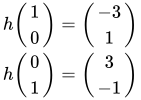
Both vectors are linearly dependent. So it follows that  and thus
  .
.
Finally, we determine the image of  . For this we proceed for example as with .
![{\displaystyle {\begin{aligned}\operatorname {im} (k)&=\left\{k{\begin{pmatrix}x\\y\end{pmatrix}}\mid {\begin{pmatrix}x\\y\end{pmatrix}}\in \mathbb {R} ^{2}\right\}\\&=\left\{{\begin{pmatrix}x\\0\end{pmatrix}}\mid {\begin{pmatrix}x\\y\end{pmatrix}}\in \mathbb {R} ^{2}\right\}\\&=\left\{x{\begin{pmatrix}1\\0\end{pmatrix}}\mid {\begin{pmatrix}x\\y\end{pmatrix}}\in \mathbb {R} ^{2}\right\}\\&{\color {OliveGreen}\left\downarrow \ {\text{The left side does not depend on }}y\right.}\\[0.3em]&=\left\{x{\begin{pmatrix}1\\0\end{pmatrix}}\mid x\in \mathbb {R} \right\}\\&=\operatorname {span} \left({\begin{pmatrix}1\\0\end{pmatrix}}\right)\end{aligned}}}](./_assets_/eb734a37dd21ce173a46342d1cc64c92/e5acc43adc661ee1cd1beb09cd1b2adf70cd11ab.svg)
So the image of is spanned by the vector  . Thus
  is the -axis, so
  .
.
How to get to the proof? (Surjectivity and dimension of and )
We want to estimate the dimensions of and against each other. The dimension is defined as the cardinality of a basis. That is, if  is a basis of and
  is a basis of , we must show that
  holds if and only if there exists a surjective linear map. "if and only if" means that we need to establish two directions (
 ).
).
Given a surjective linear map , we must show that the dimension of is at least  . Now bases are maximal linearly independent subsets. That is, to estimate the dimension from below, we need to construct a linearly independent subset with elements. In the figure, we have already a linearly independent subset with elements, which is the basis . Because is surjective, we can lift these to vectors
  with
with  . Now we need to verify that
  are linearly independent in . We see this, by converting a linear combination
  via into a linear combination
  and exploiting the linear independence of .
Conversely, if holds, we must construct a surjective linear map . Following the principle of linear continuation, we can construct the linear map by specifying how acts on a basis of . For this we need elements of on which we can send . We have already chosen a basis of above. Therefore, it is convenient to define as follows:
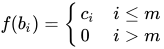
Then the image of is spanned by the vectors  . However, these vectors also span all of and thus is surjective.
Solution (Surjectivity and dimension of and )
Proof step: " "
"
Suppose there is a suitable surjective mapping . We show that the dimension of 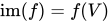 cannot be larger than the dimension of (this is true for any linear map). Because of the surjectivity of , it follows that
  .
.
So let  be linearly independent. There exists
  with
with  for
for 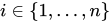 . We show that
  are also linearly independent: Let
  with
with  . Then we also have that

By linear independence of  , it follows that
  . So are also linearly independent. Overall, we have shown that

In particular, it holds that a basis of (a maximal linearly independent subset of ) must contain at least as many elements as a basis of , that is,  .
.
Proof step: " "
"
Assume that  . We use that a linear map is already uniquely determined by the images of the basis vectors. Let
 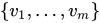 be a basis of and
 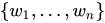 be a basis of . Define the surjective linear map by
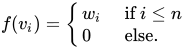
This works, since by assumption,  holds. The mapping constructed in this way is surjective, since by construction,
  . As the image of is a subspace of , the subspace generated by these vectors, i.e., , also lies in the image of . Accordingly,
  holds and is surjective.
Exercise (Image of a matrix)
- Consider the matrix
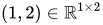 and the mapping
  induced by it. What is the image ?
- Now let
 be any matrix over a field , where
  denote the columns of . Consider the mapping
  induced by . Show that
  holds. So the image of a matrix is the span of its columns.
Solution (Image of a matrix)
Solution sub-exercise 2:
Proof step: ""
Let  . Then, there is some
  with
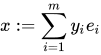
with  . We can write as
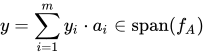
  . Plugging this into the equation , we get.
![{\displaystyle {\begin{aligned}y&=Ax\\&{\color {OliveGreen}\left\downarrow \ x=\sum _{i=1}^{m}x_{i}e_{i}\right.}\\[0.3em]&=A\left(\sum _{i=1}^{m}x_{i}e_{i}\right)\\[0.3em]&{\color {OliveGreen}\left\downarrow \ {\text{application of }}A{\text{ is linear}}\right.}\\[0.3em]&=\sum _{i=1}^{m}x_{i}Ae_{i}\\[0.3em]&{\color {OliveGreen}\left\downarrow \ Ae_{i}=a_{i}{\text{, the }}i{\text{-th column of }}A\right.}\\[0.3em]&=\sum _{i=1}^{m}x_{i}a_{i}.\end{aligned}}}](./_assets_/eb734a37dd21ce173a46342d1cc64c92/33a00acb8541db4c18d0e1d4dfc0914f1841aa3a.svg)
Since 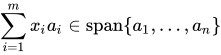 , we obtain
  .
.
Proof step: ""






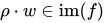



![{\displaystyle {\begin{aligned}&w_{1}+w_{2}\\[0.3em]&{\color {OliveGreen}\left\downarrow \ f(v_{1})=w_{1}{\text{ and }}f(v_{2})=w_{2}\right.}\\[0.3em]=\ &f(v_{1})+f(v_{2})\\[0.3em]&{\color {OliveGreen}\left\downarrow \ f{\text{ is linear}}\right.}\\[0.3em]=\ &f(v_{1}+v_{2})\end{aligned}}}](./_assets_/eb734a37dd21ce173a46342d1cc64c92/909a4f79e553fff753a8d953b27f6fb90620537c.svg)



![{\displaystyle {\begin{aligned}&\rho \cdot w\\[0.3em]&{\color {OliveGreen}\left\downarrow \ w=f(v)\right.}\\[0.3em]=\ &\rho \cdot f(v)\\[0.3em]&{\color {OliveGreen}\left\downarrow \ f{\text{ is linear}}\right.}\\[0.3em]=\ &f(\rho \cdot v)\end{aligned}}}](./_assets_/eb734a37dd21ce173a46342d1cc64c92/35c60b7037fa8a7e879c56c1de5c00eca6aba0f5.svg)