In this article, we will learn how to describe linear maps between arbitrary finite-dimensional vector spaces using matrices. The matrix representing such a linear mapping  depends on the choice of bases in
  and in
  . Their columns are the coordinates of the images of the base vectors of .
Generalization to abstract vector spaces
In the article on introduction to matrices, we saw how we can describe a linear mapping  using a matrix. In this way, we can specify and classify linear mappings between
  and
and  quite easily. Can we also find such a description for linear mappings between general vector spaces?
Formally speaking, we care asking: Given two finite-dimensional  vector spaces and , how can we completely describe a linear mapping ?
To answer this question, we can try to trace it back to the case of and . In the article on isomorphisms we have seen that every finite-dimensional vector space is isomorphic to . This means  and
and  , where we set
  and
and 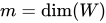 . This isomorphism works as follows: We choose an ordered basis
  from . By representing a vector in with respect to
  , we obtain the coordinate mapping
 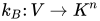 , which maps
  to
to  . In the same way, we obtain the isomorphism
  after choosing a basis
  of . It is important here that and are ordered bases, as we would get a different mapping for different arrangements of the basis vectors.
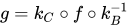
Using these isomorphisms, we can turn our mapping into a mapping 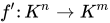 : We set
We can assign a matrix  to this mapping
  as described in the article Introduction to matrices.
Have we achieved our goal? If so, we can reconstruct the mapping  from . From the article introduction to matrices, we already know that we can reconstruct the mapping from using the induced mapping. Now
  and
and  are isomorphisms. This means that we can reconstruct from via
  .
.
We can therefore call the matrix assigned to . However, we have to be careful with this name: the matrix depends on the choice of the two ordered bases of and of . This means we have actually found several ways to construct a matrix from . Only after fixing the bases and have we found a unique way to get a matrix for . Thus, the matrix constructed above should actually be called “the matrix assigned to with respect to the bases and ”. Appropriately, we can denote by  . By construction, this matrix fills exactly the bottom row in the following diagram:
Definition
Warning
Note that the matrix depends on the selected (ordered) bases and ! If you choose other bases, you generally get a different matrix. This also applies if you only change the order of the base vectors. This is why we use ordered bases.
Hint
The matrix of a linear map is also called the representation matrix or assigned matrix.
Calculating with matrices of linear maps
Computing the matrix of a linear map
How can we find the corresponding matrix for ? That is, how can we specifically calculate the entries of the matrix ?
The  -th column vector of the matrix is given by
  . We therefore want to determine this vector. Now,
  . The defining property of the coordinate mapping is that it maps the basis vector
  to
to  . Therefore,
  . Thus, the -th column of is the vector
  . To find out how represents the vector
  , we need to represent this vector in the basis . There are scalars
  , so that
 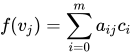 . Then,
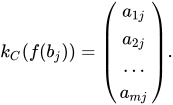
This means that the  -th entry of is given by the entry
  from the basic representation
 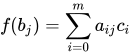 .
.
Definition (Matrix of a linear map, alternative definition)
Let be a field and and two finite-dimensional -vector spaces. Let  be a basis of and
  a basis of . Let be a linear mapping.
Further, let
a basis of . Let be a linear mapping.
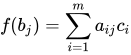
Further, let  be such that
  for all
 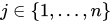 . Then we define the matrix of with respect to and as the matrix
  .
.
Using the matrix of a linear map
Now we know how to calculate the matrix of with respect to the bases  and
and  . What can we use this matrix for?
This matrix can be used to calculate the image vector  of each
  . To do so, we first represent
  with respect to the basis of , i.e.,
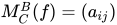
  . We denote the entries of the mapping matrix with
  . Then we have
![{\displaystyle {\begin{aligned}f(v)&=f\left(\sum _{j=1}^{n}\lambda _{j}b_{j}\right)\\[0.3em]&{\color {OliveGreen}\left\downarrow \ {\text{linearity of }}f\right.}\\[0.3em]&=\sum _{j=1}^{n}\lambda _{j}f(b_{j})\\[0.3em]&{\color {OliveGreen}\left\downarrow \ {\text{definition of the matrix }}M_{C}^{B}(f)=(a_{ij})\right.}\\[0.3em]&=\sum _{j=1}^{n}\lambda _{j}\left(\sum _{i=1}^{m}a_{ij}c_{i}\right)\\[0.3em]&{\color {OliveGreen}\left\downarrow \ {\text{re-arranging the sum }}\right.}\\[0.3em]&=\sum _{i=1}^{m}\left(\sum _{j=1}^{n}a_{ij}\lambda _{j}\right)c_{i}\\[0.3em]\end{aligned}}}](./_assets_/eb734a37dd21ce173a46342d1cc64c92/789737405c03db5f426ba9161c9ade19b2544e6d.svg)
We therefore obtain a representation of the vector 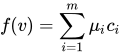 as a linear combination of the basis vectors of , with coordinates
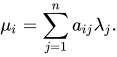
Using the matrix multiplication with a vector (“row times column”) we can also express this as follows:
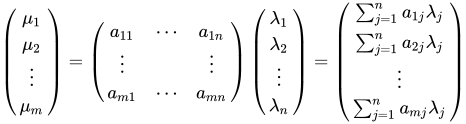
Using the matrix of , we therefore obtain the coordinate vector  of from the coordinate vector
  of : We multiply
  from the left by the matrix .

The equation states that, starting from a vector , the red and blue paths in the diagram for the matrix to be displayed provide the same result.
Instead of starting with a vector , we can also start with any vector  . Then
  is the coordinate vector of
  . We can also understand the product
  as a coordinate vector of
  . From the diagram, we know that
  is the coordinate vector of . Therefore,

Here we have used the fact that the coordinate mappings are isomorphisms, so we can also reverse the arrows of and in the diagram. The equation states that the red and blue paths in the following diagram give the same result:
Example (Using the matrix of a linear map)
As above, we consider the linear map
![{\displaystyle {\begin{aligned}f\colon \mathbb {R} [x]_{\leq 2}&\to \mathbb {R} [x]_{\leq 1}\\p=p_{2}x^{2}+p_{1}x+p_{0}&\mapsto (p_{2}+p_{1})(x+1)+p_{0}\end{aligned}}}](./_assets_/eb734a37dd21ce173a46342d1cc64c92/f4b836d757269fc34eae57eefc109737ef4323f1.svg)
and the bases 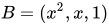 of
of ![{\displaystyle \mathbb {R} [x]_{\leq 2}}](./_assets_/eb734a37dd21ce173a46342d1cc64c92/814b31d8cca742c32d775595b226463a7ad780fb.svg) or
or  of
of ![{\displaystyle \mathbb {R} [x]_{\leq 1}}](./_assets_/eb734a37dd21ce173a46342d1cc64c92/b03a9350e9269cdf37f119d3a552895ecb6252d8.svg) .
.
We have already calculated the matrix of with respect to these bases:
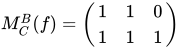
We can now use this matrix to calculate  for a polynomial
 ![{\displaystyle p\in \mathbb {R} [x]_{\leq 2}}](./_assets_/eb734a37dd21ce173a46342d1cc64c92/c7d37b65c92ac8ae1889f7519d2207994b477419.svg) . We have seen above that
. We have seen above that

To understand this, let's look at a concrete example:
We consider the polynomial  . First, we need to calculate
  , i.e., the coordinates with respect to the basis . The coordinate vector is formed from the prefactors of the linear combination in the basis . We have

This allows us to find the coordinate vector
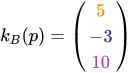
We can multiply this vector with the matrix :
![{\displaystyle {\begin{aligned}&M_{C}^{B}(f)k_{B}(p)\\[0.5em]=&{\begin{pmatrix}1&1&0\\1&1&1\end{pmatrix}}{\begin{pmatrix}5\\-3\\10\end{pmatrix}}\\[0.5em]=&{\begin{pmatrix}2\\12\end{pmatrix}}\end{aligned}}}](./_assets_/eb734a37dd21ce173a46342d1cc64c92/1ccc722061788d9dbdf7201875773146008c2a99.svg)
This vector  is
is  , i.e., the coordinate vector of in the basis . In order to obtain from this, we must write the coordinates in the vector as prefactors in the linear combination of . Thus

Matrix of a composition of linear maps
In the following theorem we show that the combination of linear mappings corresponds to the multiplication of their representing matrices.
Theorem (Matrix of a composition of linear maps)
Let and  be linear mappings between finite-dimensional vector spaces. Furthermore, let
  be a basis of ,
  a basis of and
  a basis of
  . Then

Proof (Matrix of a composition of linear maps)
Let  and let
  . Further, let
  and
and  be the matrices of and
  respectively.
We now know that the  are the unique scalars, satisfying
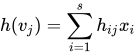
for all  . In order to prove
  , we need to verify
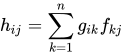
Indeed,
![{\displaystyle {\begin{aligned}h(v_{j})&=\,g(f(v_{j}))\\[0.3em]&{\color {OliveGreen}\left\downarrow {\text{definition of }}M_{C}^{B}(f)\right.}\\[0.3em]&=\,g\left(\sum _{k=1}^{n}f_{kj}w_{k}\right)\\[0.3em]&{\color {OliveGreen}\left\downarrow {\text{linearity of }}g\right.}\\[0.3em]&=\,\sum _{k=1}^{n}f_{kj}g(w_{k})\\[0.3em]&{\color {OliveGreen}\left\downarrow {\text{definition of }}M_{D}^{C}(g)\right.}\\[0.3em]&=\,\sum _{k=1}^{n}f_{kj}\sum _{i=1}^{s}g_{ik}x_{i}\\[0.3em]&=\,\sum _{i=1}^{s}\left(\sum _{k=1}^{n}g_{ik}f_{kj}\right)x_{i}.\end{aligned}}}](./_assets_/eb734a37dd21ce173a46342d1cc64c92/84e27c8a2ce1ca7356ee4d494e6230ec0fe0384d.svg)
From the uniqueness of the coordinates in the linear combination of  , we conclude .
One-to-one correspondence between matrices and linear maps
We can uniquely assign a matrix to a linear map after a fixed choice of ordered bases and . This gives us a function that sends a mapping to its associated matrix :
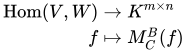
In this formula,  is the set of all linear maps from to and
  is the set of all
  matrices.
How did we arrive at the assignment of the matrix to the linear map ? We first found a unique mapping for using the bases and and then determined the matrix assigned to . The mapping is defined by the coordinate mappings: . So we have the assignment:

Because and are bijections, we can also get a unique from an , to which is assigned. All we have to do is to set  .
.
So we have a bijection between and  .
.
The assignment
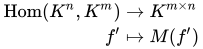
is a bijection, as we already saw in the introduction article to matrices.
Therefore,  is also a bijection, because it is the combination of the two bijections
  and . But what does the inverse of the bijection look like?
The inverse mapping  sends a matrix
  to a linear map such that
  . Let and
  be ordered bases of and and
  , i.e., is the
  -th component of the matrix
  . Because , the following must hold:
Because of the principle of linear continuation, is already completely defined. Here, we see that is the weight of  in . Intuitively, the -th column of the mapping matrix again stores the image of the -th basis vector, i.e., .
Example (One-to-one correspondence)
We want to better understand the one-to-one correspondence between matrices and linear mappings using an example. The bijection is given by
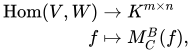
where is an (ordered) basis of and is an (ordered) basis of .
We consider the two  vector spaces
 ![{\displaystyle V=\mathbb {R} [x]_{\leq 2}}](./_assets_/eb734a37dd21ce173a46342d1cc64c92/5a3fcf0f53f0a63784aca5bf746ff7395c0cd309.svg) and
and ![{\displaystyle W=\mathbb {R} [x]_{\leq 1}}](./_assets_/eb734a37dd21ce173a46342d1cc64c92/9d6254e6a7404d800f81bcbab2b69b9350618707.svg) , i.e., the vector spaces of the polynomials with coefficients from and degree at most 2 or 1.
For the one-to-one correspondence, we still need an ordered basis of and of . We choose the canonical bases
, i.e., the vector spaces of the polynomials with coefficients from and degree at most 2 or 1.
For the one-to-one correspondence, we still need an ordered basis of and of . We choose the canonical bases 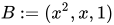 and
and  . What are the variables
  and
and  in this example? The number is the dimension of the vector space and is the dimension of . So
  and
and  .
.
We therefore have the bijection
![{\displaystyle {\begin{aligned}\operatorname {Hom} (\mathbb {R} [x]_{\leq 2},\mathbb {R} [x]_{\leq 1})&\to \mathbb {R} ^{2\times 3}\\f&\mapsto M_{C}^{B}(f)\end{aligned}}}](./_assets_/eb734a37dd21ce173a46342d1cc64c92/050f67fc81b4e809e3982aa84a3fa44149698155.svg)
This means every linear map from to provides a  matrix
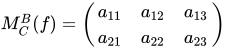
with coefficients  . For example, we have seen above that for the linear map
and the bases and , we get the corresponding matrix
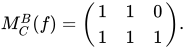
However, the one-to-one correspondence says even more: For every -matrix with coefficients in there is a unique linear mapping from to , so that is the mapping matrix of , i.e., .
Hint
If we choose a suitable vector space structure on the set of matrices , the bijection explained above is even an isomorphism. The vector space structure we have to fix for the matrices is componentwise addition and scalar multiplication. We look at this in more detail in the article “Vector space structure on matrices”.
Examples
We calculate the matrix representing a specific linear map  with respect to the standard basis.
Example (Concrete example)
We consider the linear map
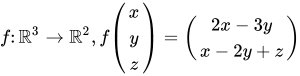
The canonical standard basis is selected both in the original space  and in the target space
  :
:

We have:

This means that the matrix of  with respect to the selected bases and is:
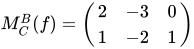
Now let's look at the same linear map, but a different basis in the target space.
Example (Concrete example with a different basis)
Again, we consider the linear map of the above example, i.e.,
This time we use the ordered basis in the target space
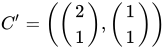
Now,
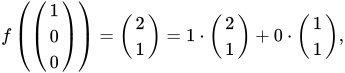

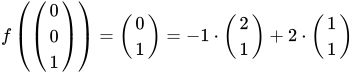
This gives the following matrix of with respect to the bases and  :
:
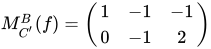
We can see that this matrix is not equal to from the first example.
From the two previous examples, we see that the matrix representing a linear map depends on the chosen bases. It is important that we consider ordered bases: The representing matrix also depends on the order of the basis vectors.
Example (Concrete example with a re-arranged basis)
Again, we consider the linear map of the above example, i.e.,
This time we use the reordered standard basis in the target space
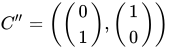
Now,
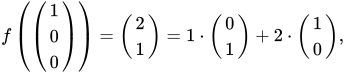

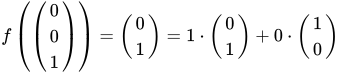
This gives the following matrix of with respect to the bases and  :
:
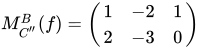
We can see that this matrix is neither equal to from the first nor to the one from the second example. (In fact, it is the from the first example with the rows being swapped.)
Conversely, different mappings can also have the same mapping matrix if they are evaluated for different bases:
Example (Concrete example with a different linear map but the same matrix)
Consider the linear map
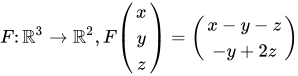
We select the standard basis for both the original and target space:
and, as in the previous examples, we calculate the matrix representing  with respect to these bases as
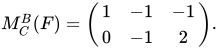
This is the same matrix as the  from the previous example. But the linear maps and are not identical, because
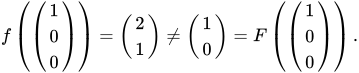
Let us now look at a somewhat more abstract example:
Example (Polynomials of different degrees)
Let  and let be the vector space of polynomials of degree at most 3 with coefficients from . Further, let the vector space of polynomials of degree at most 2 with coefficients from .
We define
and let be the vector space of polynomials of degree at most 3 with coefficients from . Further, let the vector space of polynomials of degree at most 2 with coefficients from .
We define  as the derivative of a polynomial, i.e., for all
  we set
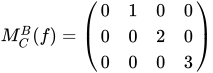
  . When considering the bases:
  and
and 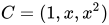 , then the following applies:




This gives the following matrix of with respect to the bases and :