Multi-configuration time-dependent Hartree
Multi-configuration time-dependent Hartree (MCTDH) is an approach to quantum molecular dynamics, an algorithm to solve the time-dependent Schrödinger equation for multidimensional dynamical systems consisting of distinguishable particles. The nuclei of molecules is one example of such particles and their vibrational motion is a form of time-dependence. The method uses an overall wavefunction composed of products of single-particle wavefunctions as first proposed by Douglas Hartree in 1927. The "multiconfiguration" part of the method refers to combining multiple such products.[1]: 37
MCTDH can predict the motion of the nuclei of a molecular system evolving on one or several coupled electronic potential energy surfaces. It is an approximate method whose numerical efficiency decreases with growing accuracy.[2]
MCTDH is suited for multi-dimensional problems, in particular for problems that are difficult or even impossible to solve in conventional ways.
Methods
Basic algorithm
Wavefunction expansion

Where the number of configurations is given by the product . The single particle functions (SPFs), , are expressed in a time-independent basis set:


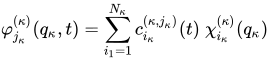
Where is a primitive basis function, in general a Discrete Variable Representation (DVR) that is dependent on coordinate .[1] If , one returns to the Time Dependent Hartree (TDH) approach.[3] In MCTDH, both the coefficients and the basis function are time-dependent and optimized using the variational principle.


Equations of motion
Lagrangian Variational Principle
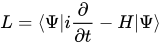
Where:
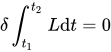
Which is subject to the boundary conditions . After integration, one obtains:

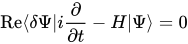
McLachlan Variational Principle
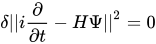
Where only the time derivative is to be varied. We can rewrite this norm squared term as a scalar product, and vary the bra and ket side of the product:
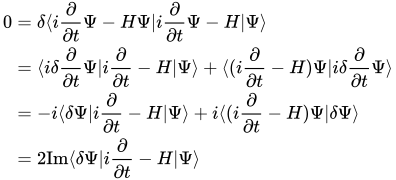
Dirac-Frenkel Variational Principle
If each variation of is an allowed variation, then both the Lagrangian and the McLanchlan Variational Principle turn into the Dirac-Frenkel Variational Principle:

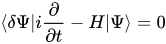
Which simplest and thus preferred method of deriving the equations of motion.[1]
Multi-layer extension
Motivation
The original ansatz of MCTDH generates a single layer tensor tree; however, there is a limit to the size and complexity this single layer can handle. This prompted the development of a multilayer (ML)-MCTDH ansatz by Manthe[4] which was then generalized by Vendrell and Meyer.[5]
Tensor Tree Formalism
Multiple layers are generated through the creation of a tensor tree of nodes linking the modes (DOFs). Solving the tree layout is an NP-hard problem, but strides have been taken to automate this process through mode correlations by Mendive-Tapia.[6]
Wave function expansion
The generalized ML expansion of Meyer[5] can be written as follows:
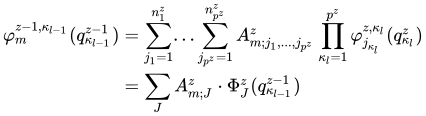
Where the coordinates are combined as

Equations of motion
Where the equations of motion are now represented as follows:
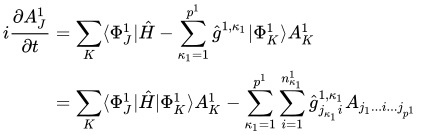
The SPF EOMs are formally defined the same for all layers:

Where is a Hermitian gauge operator defined as follows:


Examples of uses in literature
NOCl
The first verification of the MCTDH method was with the NOCl molecule. Its size and asymmetry makes it a perfect test bed for MCTDH: it is small and simple enough for its numerics to be manually verified, yet complicated enough for it to already squeeze advantages against conventional product-basis methods.[7]
Water clusters
The solvation of the hydronium ion is a topic of continued research. Researchers have been able to successfully use MCTDH to model the Zundel[8] and Eigen[9] ions in close agreement with experiment.
Limitations
| Method | Degrees of Freedom Possible |
|---|---|
| Conventional Methods (e.g. TDH) | 6 |
| MCTDH | 12[2] |
| ML-MCTDH | 24+[5] |
| ML-MCTDH with the Spin-Boson Model | 1000+[10] |
For a typical input in ML-MCTDH to be run, a node tree, potential energy surface, and equations of motion must be generated by the user.[11] These prerequisites—along with total compute time—soft-cap the size of systems able to be studied with ML-MCTDH; however, advances in neural networks have been shown to address the difficulty of the generation of potential energy surfaces.[12] These issues can also by circumvented by using the spin-boson or other similar bath models that do not pose the same assignment challenges.[10]
Software packages implementing the MCTDH method
| Package Name | Group | University | Link |
|---|---|---|---|
| Heidelberg MCTDH | TC Group | Heidelberg University | Link[13] |
| QUANTICS | Worth | UCL | Link[14] |
| MCTDH-X | N/A | ETH Zurich | Link[15] |
Example Usage of the Heidelberg Package for NOCl
Input and Operator File
| nocl0.inp | nocl0.op |
|---|---|
RUN-SECTION relaxation tfinal= 50.0 tout= 10.0 name = nocl0 overwrite output psi=double timing end-run-section OPERATOR-SECTION opname = nocl0 end-operator-section SBASIS-SECTION rd = 5 rv = 5 theta = 5 end-sbasis-section pbasis-section #Label DVR N Parameter rd sin 36 3.800 5.600 rv HO 24 2.136 0.272,ev 13615.5 theta Leg 60 0 0 end-pbasis-section INTEGRATOR-SECTION CMF/var = 0.50 , 1.0d-5 BS/spf = 10 , 1.0d-7 SIL/A = 12 , 1.0d-7 end-integrator-section INIT_WF-SECTION build rd gauss 4.315 0.0 0.0794 rv HO 2.151 0.0 0.218,eV 13615.5 theta gauss 2.22 0.0 0.0745 end-build end-init_wf-section ALLOC-SECTION maxkoe=160 maxhtm=220 maxhop=220 maxsub=60 maxLMR=1 maxdef=85 maxedim=1 maxfac=25 maxmuld=1 maxnhtmshift=1 end-alloc-section end-input |
OP_DEFINE-SECTION
title
NOCl S0 surface
end-title
end-op_define-section

PARAMETER-SECTION
mass_rd = 16.1538, AMU
mass_rv =  7.4667, AMU
end-parameter-section

HAMILTONIAN-SECTION
---------------------------------------------------------
modes         |  rd           |  rv           | theta
---------------------------------------------------------
0.5/mass_rd   |  q^-2         |  1            | j^2
0.5/mass_rv   |  1            | q^-2          | j^2
1.0           |  KE           |  1            |  1
1.0           |  1            |  KE           |  1
1.0           |1&2&3  V
---------------------------------------------------------
end-hamiltonian-section

LABELS-SECTION
V = srffile {nocl0um, default}
end-labels-section

end-operator
|
Output absorption spectrum
References
- ^ a b c Meyer, Hans-Dieter. "Introduction to MCTDH" (PDF). Theoretical Chemistry Group. Heidelberg University. Retrieved 25 October 2025.
- ^ a b Meyer, Hans-Dieter. "Multi-Configurarion time-dependent Hartree". Theoretical Chemistry Group Heidelberg. Heidelberg University. Retrieved 25 October 2025.
- ^ McLachlan, A. D.; Ball, M. A. (1964). "Time-Dependent Hartree—Fock Theory for Molecules". Reviews of Modern Physics. 36 (3): 844–855. doi:10.1103/RevModPhys.36.844. Retrieved 25 October 2025.
- ^ Manthe, Uwe (2008). "A multilayer multiconfigurational time-dependent Hartree approach for quantum dynamics on general potential energy surfaces". The Journal of Chemical Physics. 128 (16): 164116. doi:10.1063/1.2902982. Retrieved 25 October 2025.
- ^ a b c Vendrell, Oriol; Meyer, Hans-Dieter (2011). "Multilayer multiconfiguration time-dependent Hartree method: Implementation and applications to a Henon–Heiles Hamiltonian and to pyrazine". The Journal of Chemical Physics. 134 (4): 044135. arXiv:1012.4625. doi:10.1063/1.3535541. Retrieved 25 October 2025.
- ^ Mendive-Tapia, David; Meyer, Hans-Dieter; Vendrell, Oriol (2023). "Optimal Mode Combination in the Multiconfiguration Time-Dependent Hartree Method through Multivariate Statistics: Factor Analysis and Hierarchical Clustering". Journal of Chemical Theory and Computation. 19 (4): 1144–1156. doi:10.1021/acs.jctc.2c01089.
- ^ Manthe, Uwe; Meyer, Hans-Dieter; Cederbaum, Lorenz (1992). "Wave‐packet dynamics within the multiconfiguration Hartree framework: General aspects and application to NOCl". The Journal of Chemical Physics. 97 (5): 3199–3213. doi:10.1063/1.463007. Retrieved 27 October 2025.
- ^ Vendrell, Oriol; Gatti, Fabien; Meyer, Hans-Dieter (2007). "Full dimensional (15-dimensional) quantum-dynamical simulation of the protonated water dimer. II. Infrared spectrum and vibrational dynamics". The Journal of Chemical Physics. 127 (18): 184303. arXiv:0707.1004. doi:10.1063/1.2787596. Retrieved 25 October 2025.
- ^ Schröder, Markus; Gatti, Fabien; Lauvergnat, David; Meyer, Hans-Dieter; Vendrell, Oriol (2022). "The coupling of the hydrated proton to its first solvation shell". Nature Communications. 13: 6170. doi:10.1038/s41467-022-33650-w. PMC 9579203. Retrieved 25 October 2025.
- ^ a b Wang, Haobin (2019). "Quantum Phase Transition in the Spin-Boson Model: A Multilayer Multiconfiguration Time-Dependent Hartree Study". The Journal of Physical Chemistry A. 123 (9): 1882–1893. doi:10.1021/acs.jpca.8b11136. Retrieved 25 October 2025.
- ^ Meyer, Hans-Dieter. "The Heidelberg MCTDH Package: A set of programs for multi-dimensional quantum dynamics" (PDF). User's Guide. Heidelberg University. Retrieved 25 October 2025.
- ^ Marx, Dominik. "RubNNet4MD". Center for Theoretical Chemistry. Ruhr-Universität Bochum. Retrieved 25 October 2025.
- ^ http://mctdh.uni-hd.de/
- ^ https://www2.chem.ucl.ac.uk/quantics/doc/index.html
- ^ http://ultracold.org/menu/
Further reading
Meyer, Hans-Dieter (2009). Multidimensional Quantum Dynamics: MCTDH Theory and Applications (PDF) (1 ed.). Hoboken: John Wiley & Sons, Incorporated. ISBN 978-3-527-32018-9.