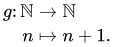
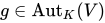
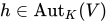
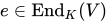
An endomorphism is a linear deformation of a vector space  . Formally, an endomorphism is a linear mapping
  that sends to itself, i.e.,
  . A bijective endomorphism is called an automorphism. Intuitively, an automorphism is a linear deformation that can be undone.
Derivation
We already know linear maps. These are mappings between two vector spaces which are compatible with the (linear) vector space structure. We now examine a few examples of linear maps that we have already learned about in previous articles.
Examples in the 
Stretching in  -direction
First, we consider the stretching of a vector in the plane by a factor of  in the -direction. Our mapping is thus

One can easily verify that is a linear map. We can illustrate as follows: We place a checkerboard pattern in the plane and apply to this checkerboard pattern.
The result is that the boxes are stretched by a factor of in the -direction.
Rotation around the origin
We now consider a rotation  by the angle
  counter-clockwise, with the origin as center of rotation. This is a mapping
 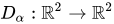 which assigns to each vector
  the vector
  rotated by the angle :
In the introductory article on linear maps we have seen that rotations about the origin are linear. We can visualize as in the first example by applying the mapping to the checkerboard pattern. The individual squares then sustain their shape, but they are rotated.
Projection on a line
At last we consider the map

The map  "presses" vectors onto the straight line
  .
You can easily check that is a linear map.
We also apply this linear map to the checkerboard pattern to visualize it.
.
You can easily check that is a linear map.
We also apply this linear map to the checkerboard pattern to visualize it.
The entire grid is "flattened" onto the straight line  .
.
In all the above examples, we were able to visualize the linear maps as distortions of the checkerboard pattern in . This was possible because all of the above functions map from into itself. We can illustrate any linear maps  as a deformation of a checkerboard. The deformation of the checkerboard shows us how the map acts on the standard basis vectors
  and
and  of and integer multiples of them.
Any linear map is a linear deformation of the space . Let us generalize this idea to general vector spaces . We can think of linear maps from to as linear deformations or transformations of the vector space . In contrast, a linear map is a transport of the vector space to  . We give a separate name to a linear map which deforms the vector space, i.e., which maps from to : Such a linear map will be called an endomorphism. So endomorphisms are just those linear maps for which the domain of definition and the target space coincide.
In the examples in we have seen that some deformations preserve the space and others "flatten" it in a certain sense. The mappings that preserve space can be undone. When the space is flattened, the ma cannot be undone because information is lost. For example, in the above linear map "projection onto a straight line", information is lost about what the  -component of the original vector was. It is not possible to recover the vector after applying the transformation. So there are deformations of space that can be undone, and some that cannot. One can undo a deformation exactly if the associated mapping is bijective, i.e., invertible. This gives us the definition of a reversible deformation of space, i.e., an invertible endomorphism. Such a mapping is called an automorphism.
Definition
Hint
Every automorphism is a bijective linear map and therefore also an isomorphism. But not every isomorphism is an automorphism. This is because isomorphisms can also map two different vector spaces to each other.
Examples
Examples in
Reflection
We consider the linear map  . Since it maps the vector space into itself, is an endomorphism. The mapping preserves and sends to
  . Thus, we can think of as a reflection along the -axis. We can undo a reflection by reflecting a second time. This means is its own inverse mapping. Formally, this is denoted
  or
or  . Such a mapping is also called "self-inverse." Because has an inverse, that is, it is invertible, it follows that is bijective. Thus, is also an automorphism.
Rotation by 90°
Next we consider the endomorphism  . This is a counter-clockwise rotation by
  degrees. To convince yourself that really is such a rotation, you may calculate how acts on the standard basis vectors and . If it is such a rotation on these two vectors, then by linearity, must be such a rotation everywhere. A short calculation gives
  , as well as
  , which is exactly the desired rotation. Again, we can easily specify an inverse by "turning back" or rotating clockwise by degrees. This rotation is given by
  . We briefly check that
  is indeed the inverse of :
{\begin{pmatrix}x\\y\end{pmatrix}}&=g{\begin{pmatrix}-y\\x\end{pmatrix}}={\begin{pmatrix}x\\-(-y)\end{pmatrix}}={\begin{pmatrix}x\\y\end{pmatrix}}\end{aligned}}}](./_assets_/eb734a37dd21ce173a46342d1cc64c92/564e86eaf6e05e863177ea63f2ded220ab721240.svg)
for  . So
. So  and is also an automorphism in this example.
Shears
Let  .
The following animation shows how this mapping deforms the plane.
.
The following animation shows how this mapping deforms the plane.
The transformation looks reversible, that is, it looks like an automorphism.
We can check this by showing that is both injective and surjective.
To show injectivity, let us look at the kernel of , i.e., the set  . For a vector
  in the kernel, then
  holds. From this we directly get
  and therefore also
  . Thus, the kernel consists only of the zero vector and hence is injective.
To show surjectivity, we take any 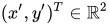 and find a suitable preimage. That means, we are looking for some with
  . It is directly clear that
  must hold. Furthermore,
  must be true. This can be transformed to
 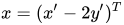 . So
. So 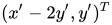 is a preimage of
  . Since was arbitrary, is surjective.
Linear maps of the form  with
with  are called shears. You can show as an exercise that a shear is always an automorphism, no matter what
  is.
is.
Flattening to the -axis
Let us now consider the mapping  . This is an endomorphism from to that maps every point on the plane to a point on the -axis. So we can think of as "flattening" the 2-dimensional plane onto the 1-dimensional -axis."
Since maps the points in exclusively onto the axis, is not a surjective mapping. Nor is it injective, because for every  we can find different
  such that
  holds, e.g.,
  and vice versa. So is not an automorphism.
Example in 
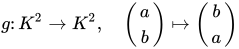
Let us now consider an example in . For this we look at the linear map  . Because maps the vector space back to , the mapping is an endomorphism.
We now want to check whether is also an automorphism. To do this, we need to check surjectivity and injectivity.
For injectivity, we consider the kernel of , that is, the set  . Thus, for vectors
  from the kernel of ,
  holds. From this we can directly conclude that
  and
and  , so
, so  , must hold. We thus see that the kernel of contains not only the zero vector, but also the set of all vectors
  . Hence, is not injective and therefore cannot be bijective. In particular, is not an automorphism.
Visually, compresses vectors onto the plane  . Thus, information is lost. Given a vector
 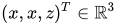 , it is no longer possible to say in an unambiguous way from which vector
 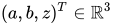 it arose under the mapping , since there are very many ways to represent
  as the sum of two numbers
  . For example,
  .
.
Example in sequence space
There are also endomorphisms on vector spaces other than and . For instance, we may take an arbitrary field  and consider, as a vector space over it, the sequence space

Now, we take the mapping
_{i}&\mapsto f\left((x_{i})_{i}\right)=(x_{k(i)})_{i},\end{aligned}}}](./_assets_/eb734a37dd21ce173a46342d1cc64c92/4787f55261758fd7de64ad2a8c768550c4686bd5.svg)
where
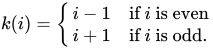
If we write out the first sequence members, the situation looks like this:

Thus, the mapping interchanges even and odd sequence members. We briefly justify why is linear. Addition and scalar multiplication in the sequence space is understood component-wise, i.e., for  and
and  and we have

Since only swaps the order of the components, is linear. We can also check linearity of explicitly.
Question: How do you directly show that is linear?
So is an endomorphism of  . Is also an automorphism? To answer that, we need to verify that can be undone. The mapping swaps even and odd sequence members. So if we swap the sequence members back, is undone. This second swap can be done by just applying again. As with the very first example, is self-inverse - in formulas this is called
  or
or  . Since is invertible, the mapping is bijective. So is an automorphism.
In the article Vector space of a linear map we saw that the set of linear maps 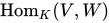 between two -vector spaces and again forms a vector space. Since
  holds, the set of endomorphisms is also a vector space. That is, we can add endomorphisms of a vector space and multiply them by scalars. In particular, we can link two endomorphisms and
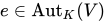
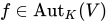
 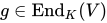 by addition and obtain an endomorphism
  . This space is given by

where  denotes addition in the vector space .
Can and be connected in another way? Intuitively, and are two representations of the vector space . We can now deform the space with and then deform the result with . This produces a new deformation of the vector space. That is, we again get an endomorphism of . This resulting mapping, that corresponds to applying and one after the other, is called composition and denoted  . Thus, the composition of two endomorphisms is always an endomorphism. In summary, we can "connect" two endomorphisms and by forming the addition
  or the composition .
Because we have composition as an operation in addition to addition,  carries more structure than just vector space structure. We will prove later that the set of endomorphisms on forms a ring with these two operations. Here, the addition in the ring is the addition of the mappings and the multiplication in the ring is the composition of the mappings.
It is now an interesting question, when the ring has a unit element and is commutative. If this was the case, we would even have a field and could build more vector spaces over it. Now, a unit element exists if there is a neutral element of multiplication. That is, if there is a 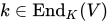 such that
  and
and  holds for all
 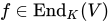 . We already know a mapping that satisfies this property: the identity
  . This is a linear map
  and so
  holds. So the ring has a unit element.
Is a commutative ring? To answer this, we need to check that  holds for all
  . To get an intuition whether the statement is true or false, we consider again examples with . Let
  be the projection onto the -axis; that is, for
  ,
,  holds. Furthermore, let
  be the rotation by
  clockwise (or by
  counter-clockwise) about the origin; that is,
  holds. We want to investigate whether . What do the maps
  and do visually? The map first pushes all space onto the -axis and then rotates it by in a clockwise direction. So our result is on the -axis.
The mapping first rotates the space by clockwise and then pushes everything to the -axis. So the result of the mapping lies on the -axis.
Consequently, and are different mappings. Therefore,  is not a commutative ring. More generally, for any vector space with
  , is not a commutative ring. We deal with this below in a corresponding exercise.
As announced above, we now prove that  is always a ring:
Proof (Endomorphism ring)
In order that forma a ring with unit, the following properties must be satisfied:
-
The tuple (
 ) is an Abelian group.
- Associative law of addition:

- Commutative law of addition:

- Existence of an additive neutral element:

- Existence of additive inverse:

-
The tuple (
 ) is a monoid
- Associative law of multiplication:

- Existence of a multiplicative neutral element:

-
The distributive laws hold
- Distributive law I:

- Distributive law II:

Before we start with the proof, let's keep the following simple fact in mind:
Let  and
and  .
The mappings
.
The mappings  and
and  map elements of to elements of .
Accordingly,
map elements of to elements of .
Accordingly,  are elements of .
By premise,
are elements of .
By premise,  is a vector space. Therefore, we can apply the computational rules that hold in the -vector space to the elements .
Proof step: () is an Abelian group
Proof step: Associative law of addition
The associative law of addition reds:
We prove this equation by establishing for all  the equality
  for each vector .
So let and . Then
+h)(x)&=(f+g)(x)+_{V}h(x)\\[0.3em]&{\color {OliveGreen}\left\downarrow \ {\text{definition of }}+\right.}\\[0.3em]&=(f(x)+_{V}g(x))+_{V}h(x)\\[0.3em]&{\color {OliveGreen}\left\downarrow \ {\text{associative law of addition in }}V\right.}\\[0.3em]&=f(x)+_{V}(g(x)+_{V}h(x))\\[0.3em]&{\color {OliveGreen}\left\downarrow \ {\text{definition of }}+\right.}\\[0.3em]&=f(x)+_{V}(g+h)(x)\\[0.3em]&{\color {OliveGreen}\left\downarrow \ {\text{definition of }}+\right.}\\[0.3em]&=(f+(g+h))(x)\\[0.3em]\end{aligned}}}](./_assets_/eb734a37dd21ce173a46342d1cc64c92/c767d65d8449bc33f53a33460132bc970bae496c.svg)
This shows the associative law of addition.
Proof step: Commutative law of addition
Proof step: Existence of an additive neutral element
We need to show the following statement:
We prove this statement by establishing: 
For this, let us choose  , where
  is the zero map from to . We now show that
  is the neutral element of the addition. For this, let
 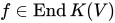 and . Then
} }+f)(x)&=0_{\operatorname {Fun(V,V)} }(x)+_{V}f(x)\\[0.3em]&{\color {OliveGreen}\left\downarrow \ {\text{definition of }}0_{\operatorname {Fun(V,V)} }\right.}\\[0.3em]&=0_{V}+_{V}f(x)\\[0.3em]&{\color {OliveGreen}\left\downarrow \ {\text{Neutral element of addition in }}V\right.}\\[0.3em]&=f(x)\\[0.3em]\end{aligned}}}](./_assets_/eb734a37dd21ce173a46342d1cc64c92/c2105b9380c0f72be90b86f12a317761aa54d192.svg)
The additive neutral element here is therefore the zero mapping .
Proof step: Existence of additive inverses
We have to show the following statement: 
This is done by establishing: 
Since is a -vector space, any vector  has an additive inverse, namely
  . Then
  holds. Therefore, for any endomorphism , we can simply choose
  . Now we still have to show that. For this, let and . Then
(x)&=f'(x)+_{V}f(x)\\[0.3em]&{\color {OliveGreen}\left\downarrow \ {\text{definition of }}f'\right.}\\[0.3em]&=-f(x)+_{V}f(x)\\[0.3em]&{\color {OliveGreen}\left\downarrow \ {\text{additive inverse in }}V\right.}\\[0.3em]&=0_{V}\\[0.3em]&{\color {OliveGreen}\left\downarrow \ {\text{definition of }}0_{\operatorname {Fun(V,V)} }\right.}\\[0.3em]&=0_{\operatorname {Fun(V,V)} }(x)\\[0.3em]\end{aligned}}}](./_assets_/eb734a37dd21ce173a46342d1cc64c92/f0773cdbfb16833fb2166e3fa6a8ddce38afab67.svg)
So the additive inverse of a mapping  is given by .
We have thus proved that 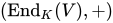 is an Abelian group.
We could have shown this statement differently. In the article Vector space of a linear map we considered the set of linear maps between two -vector spaces and . We call this set  . We have seen that forms a -vector space. It is then true that
  . So is also a vector space and thus an Abelian group.
Proof step: () is a monoid
Proof step: Associative law of multiplication
The associative law of multiplication in is:
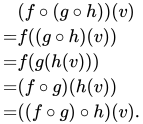
This is true because the composition of mappings is associative.
Proof step: Existence of a multiplicative neutral element
We have to establish the following statement: 
This is proven by establishing the following statement: 
We choose  , where
  is the identity on . We further want to show that
  is the neutral element of the multiplication. For this, let and . Then
(x)&=(\operatorname {id} _{V}\circ f)(x)\\[0.3em]&{\color {OliveGreen}\left\downarrow \ {\text{definition of }}\circ \right.}\\[0.3em]&=\operatorname {id} _{V}(f(x))\\[0.3em]&{\color {OliveGreen}\left\downarrow \ {\text{definition of}}\operatorname {id} _{V}\right.}\\[0.3em]&=f(x)\\[0.3em]\end{aligned}}}](./_assets_/eb734a37dd21ce173a46342d1cc64c92/912ffdcb5c58adc4326b395075759cab50474aa1.svg)
So the neutral element of the multiplication in given by the identity on , i.e.,  .
.
Proof step: Distributive laws
Proof step: Distributive law I
The distributive law I reads:
We prove this equation by establishing for all the equality  with . For this, let and . Then
)(x)&=f((g+h)(x))\\[0.3em]&{\color {OliveGreen}\left\downarrow \ {\text{definition of }}+\right.}\\[0.3em]&=f(g(x)+_{V}h(x))\\[0.3em]&{\color {OliveGreen}\left\downarrow \ {\text{f is linear}}\right.}\\[0.3em]&=f(g(x))+_{V}f(h(x))\\[0.3em]&{\color {OliveGreen}\left\downarrow \ {\text{definition of the composition}}\right.}\\[0.3em]&=(f\circ g)(x)+_{V}(f\circ h)(x)\\[0.3em]&{\color {OliveGreen}\left\downarrow \ {\text{definition of }}+\right.}\\[0.3em]&=(f\circ g+f\circ h)(x)\end{aligned}}}](./_assets_/eb734a37dd21ce173a46342d1cc64c92/a53a1951177bded2a31b868999f582d8778fc3ca.svg)
This establishes the distributive law I.
Proof step: Distributive law II
The distributive law II reads:
We prove this equation by establishing the equation  for all and . So let and . Then
\circ h)(x)&=(f+g)(h(x))\\[0.3em]&{\color {OliveGreen}\left\downarrow \ {\text{definition of }}+\right.}\\[0.3em]&=f(h(x))+_{V}g(h(x))\\[0.3em]&{\color {OliveGreen}\left\downarrow \ {\text{definition of the composition}}\right.}\\[0.3em]&=(f\circ h)(x)+_{V}(g\circ h)(x)\\[0.3em]&{\color {OliveGreen}\left\downarrow \ {\text{definition of }}+\right.}\\[0.3em]&=(f\circ h+g\circ h)(x)\end{aligned}}}](./_assets_/eb734a37dd21ce173a46342d1cc64c92/8c93362cc45ab8e269c350003b5c7eec3f3a66d3.svg)
This establishes the distributive law II.
Automorphisms and flattening
The finite-dimensional case
Above we have already examined some examples of endomorphisms and automorphisms. We have seen that endomorphisms which "flatten" a vector space are not bijective and therefore not automorphisms. On the other hand, endomorphisms which do not "flatten" a vector space are indeed automorphisms.
Question: What does "not flattening" mean in a mathematical language?
For endomorphisms of finite-dimensional vector spaces, being "non-flattening" is equivalent to being an automorphism: Let be an endomorphism of an  -dimensional vector space . If the mapping is an automorphism, then it is injective. So does not flatten . Conversely, if we assume that does not flatten , it follows that is injective. Thus, no information from is lost when mapping with . From this, we can conclude that the image
 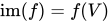 is also -dimensional. So
  must hold. Thus, is also surjective and therefore an automorphism.
We have seen that an injective endomorphism over a finite-dimensional vector space is automatically surjective. Does the converse statement also hold? In other words: If is a surjective endomorphism of a -dimensional vector space, does it follow that is injective? If is surjective, then  and hence
  holds. Suppose is not injective. Then there is a vector
  for which
  . Thus, "flattens the direction" in which
  points. This means, when mapping by , we lose at least one dimension of . Consequently, we would have
  . This is a contradiction to . Therefore, must be injective. So if is surjective, then is also injective.
To-Do:
possibly refer to an explanation in the article "Linear maps between finite dimensional vector spaces" when it is written.
We show these statements again formally in the following theorem.
The infinite-dimensional case
In the infinite-dimensional case, the above argument no longer works. We have exploited in the finite-dimensional case that for an -dimensional vector space and a subspace  it already follows from
  that
that  . Above, we used
  . However, in infinite-dimensional vector spaces this does not hold. Here, a paradoxical effect occurs: One can place an infinite-dimensional subspace
  into another infinite-dimensional space of the same size, without filling all of (This is related to Hilbert's Hotel paradox).
So for endomorphisms of an infinite-dimensional vector space , it does not hold that is surjective exactly when is injective. To understand this better, we now examine concrete counterexamples.
Example (An injective endomorphism that is not surjective)
Let  be the sequence space over
  . We define the endomorphism

You can easily verify that is linear. Why is injective? For  with
with  we have
  , so
, so  . Thus,
 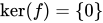 follows and is injective.
Why is not surjective? To see this, we need to find a vector in that is not "hit" by . For instance, consider  . No matter which we choose, it holds for
  that the first sequence member is equal to
  . So
. So  is never hit by . Therefore, is not surjective.
Example (A surjective endomorphism that is not injective)
We consider again the sequence space over . Now we define the endomorphism

So 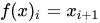 for
for 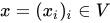 . Again, one can easily verify that is linear.
First we verify that is surjective. For this, let  be any vector. We want to find a vector for which
  holds. This is true for
  and thus is surjective.
Why is not injective? To see this, we need to find some with and  . An example is (again) given by
  . Then
  , but
, but  . Thus, is not injective.
The automorphism group
We know that the endomorphisms form a ring with unit. The automorphisms are exactly all invertible endomorphisms. In other words, the automorphisms of a vector space are exactly the multiplicatively invertible elements, of the endomorphism ring. Recall that the multiplication in the endomorphism ring is just the composition  of mappings. In the following theorem we show that
  is indeed a group with respect to this multiplication.
The automorphisms form a group, but are no longer a ring. This is because no longer has an additive structure: If we have two automorphisms and from a vector space , need not be an automorphism again. And indeed, there are counterexamples for this:
Example (Sum of automorphisms which is not an automorphism)
We consider the vector space  and define the automorphisms
![{\displaystyle {\begin{aligned}&f\colon \mathbb {R} ^{2}\to \mathbb {R} ^{2},\quad &g\colon \mathbb {R} ^{2}&\to \mathbb {R} ^{2}\\[0.3em]&{\begin{pmatrix}x\\y\end{pmatrix}}\mapsto {\begin{pmatrix}x\\y\end{pmatrix}},&{\begin{pmatrix}x\\y\end{pmatrix}}&\mapsto {\begin{pmatrix}x\\-y\end{pmatrix}}.\end{aligned}}}](./_assets_/eb734a37dd21ce173a46342d1cc64c92/6538b97d067df7a711c22e034505c702782d959a.svg)
It is easy to show that and are linear and bijective, so  . Now
. Now
![{\displaystyle {\begin{aligned}f+g\colon \mathbb {R} ^{2}&\to \mathbb {R} ^{2}\\[0.3em]{\begin{pmatrix}x\\y\end{pmatrix}}&\mapsto {\begin{pmatrix}2x\\0\end{pmatrix}}.\end{aligned}}}](./_assets_/eb734a37dd21ce173a46342d1cc64c92/a6cd31db458d377a0305d2ef46fa8e829e819d96.svg)
Since this mapping does not hit the vector , it is not surjective. So is not bijective and therefore not an automorphism.
Hint
is never closed under addition, unless  .
.
For vector spaces with the automorphism group is not commutative. As with the endomorphism ring, the composition of the mappings is not commutative. We demonstrate this non--commutativity in an exercise below.
Exercises
Exercise (Automorphism)
Show that  is an automorphism.
Solution (Automorphism)
Linearity can easily be verified. Since the domain and target space are the same, is therefore an endomorphism.
We now want to show that is bijective.
To do this, we must show that is injective and surjective.
We start with injectivity.
Let  and
and  with
with  .
Then, for
.
Then, for  we have
  , which implies
  and thus
  .
This establishes injectivity.
.
This establishes injectivity.
Now we show surjectivity.
For this, let  .
We define
.
We define  .
Then
.
Then  .
So is indeed surjective.
.
So is indeed surjective.
So we have shown that is an automorphism.
Solution (Transformation in the space of Fibonacci sequences)
Proof step: 
We show that

is an isomorphism. The linearity can be easily verified.
For injectivity we show  . So let
  with
with  , i.e.,
  . We show
  for all
  by induction. By assumption, the statement holds for
  . Now let
  be fixed. To establish the induction step, we must show that . As an induction assumption, we can use that
  for all
  . By definition of the sequence it follows that
  , which establishes the induction step and completes the induction.
For surjectivity, we use that any sequence in can be defined by specifying the first two members of the sequence: Let 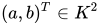 . We define
  inductively as in the proof of injectivity for
  ,
,  and
and  . Then and
  .
.
Proof step: There is an endomorphism that swaps the first two entries of each sequence.
Proof step: is an automorphism.
Exercise (Shears are automorphisms)
Let  be a scalar. We consider the mapping
  . Show that is an automorphism.
Solution (Shears are automorphisms)
The linearity of can easily be verified. Since maps to itself, is an endomorphism and all that remains is to show bijectivity.
We prove injectivity by showing  . Let
. Let  , that is,
 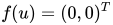 holds. We want to show
  . Since
  holds, we get
  from the second vector component. It now follows that
  and that
  holds. Thus, is injective.
Second, we need to show that is surjective. For this, let  . We must show that there exists a
  with
with  . If we insert the definition of , the vector
  we are looking for must thus satisfy
  . That is,
  must hold. From this we get
  , so
, so  . If we set
  , the following is true

So is surjective.
Since is bijective and an endomorphism, it is also an automorphism.
Solution (Non-commutativity in the endomorphism ring)
Let  a basis of , where by assumption
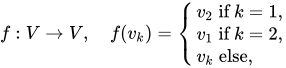
  holds. We define two noncommutative endomorphisms
  using the principle of linear continuation, by specifying the images of the basis vectors: For
 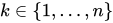 set
set
and

So the mapping swaps the first two basis vectors, while maps the first basis vector to the zero vector. In defining and we needed that there are basis vectors. For we now have
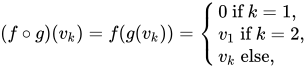
but
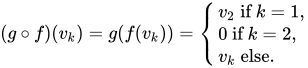
The basis vector  is an element of the basis
  of , so it cannot be the zero vector. Therefore

So  holds. Thus, the endomorphism ring is not commutative if
  .
.
Solution (Commutativity in the endomorphism ring)
Let  be a basis of and let be arbitrary. Endomorphisms are already uniquely determined by the images of the basis vectors. Since there is only one basis vector due to
  , we have
  and thus

for certain  . Since
 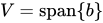 , each is of the form
  for some
  . With linearity of and the commutativity of multiplication in , it follows that

Analogously one can show  for any from which follows

Thus, for all we have

where in  we have exploited the commutativity of multiplication in .
![{\displaystyle {\begin{aligned}&f((x_{i})_{i}+(y_{i})_{i})\\[0.3em]&{\color {OliveGreen}\left\downarrow \ {\text{addition of sequences}}\right.}\\[0.3em]=&f((x_{i}+y_{i})_{i})\\[0.3em]&{\color {OliveGreen}\left\downarrow \ {\text{definition of }}f\right.}\\[0.3em]=&(x_{k(i)}+y_{k(i)})_{i}\\[0.3em]&{\color {OliveGreen}\left\downarrow \ {\text{addition of sequences}}\right.}\\[0.3em]=&(x_{k(i)})_{i}+(y_{k(i)})_{i}\\[0.3em]&{\color {OliveGreen}\left\downarrow \ {\text{definition of }}f\right.}\\[0.3em]=&f((x_{i})_{i})+f((y_{i})_{i})\end{aligned}}}](./_assets_/eb734a37dd21ce173a46342d1cc64c92/76d03e3e287da098949f9104546b9224761dab06.svg)
![{\displaystyle {\begin{aligned}&f(\lambda \cdot (x_{i})_{i})\\[0.3em]&{\color {OliveGreen}\left\downarrow \ {\text{scalar multiplication of sequences}}\right.}\\[0.3em]=&f((\lambda \cdot x_{i})_{i})\\[0.3em]&{\color {OliveGreen}\left\downarrow \ {\text{definition of }}f\right.}\\[0.3em]=&(\lambda \cdot x_{k(i)})_{i}\\[0.3em]&{\color {OliveGreen}\left\downarrow \ {\text{scalar multiplication of sequences}}\right.}\\[0.3em]=&\lambda \cdot (x_{k(i)})_{i})_{i}\\[0.3em]&{\color {OliveGreen}\left\downarrow \ {\text{definition of }}f\right.}\\[0.3em]=&\lambda \cdot f((x_{i})_{i}).\end{aligned}}}](./_assets_/eb734a37dd21ce173a46342d1cc64c92/98fbeac3c3de0f58166618fbf725f3ea6d865494.svg)









(x)&=f(x)+_{V}g(x)\\[0.3em]&{\color {OliveGreen}\left\downarrow \ {\text{commutativity of addition }}V\right.}\\[0.3em]&=g(x)+_{V}f(x)\\[0.3em]&{\color {OliveGreen}\left\downarrow \ {\text{definition of }}+\right.}\\[0.3em]&=(g+f)(x)\\[0.3em]\end{aligned}}}](./_assets_/eb734a37dd21ce173a46342d1cc64c92/d6b3b4118e092f2c57b57362cc958f6ad55084c4.svg)