Summennorm/Maximumsnorm/Schnittpunkte/1/Aufgabe/Lösung
<
Summennorm/Maximumsnorm/Schnittpunkte/1/Aufgabe
Es sei
v
=
(
x
y
)
.
{\displaystyle {}v={\begin{pmatrix}x\\y\end{pmatrix}}\,.}
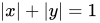
Die beiden Bedingungen sind
|
x
|
+
|
y
|
=
1
{\displaystyle {}\vert {x}\vert +\vert {y}\vert =1\,}
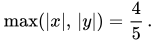
und
max
(
|
x
|
,
|
y
|
)
=
4
5
.
{\displaystyle {}\operatorname {max} \left(\vert {x}\vert ,\,\vert {y}\vert \right)={\frac {4}{5}}\,.}
Daher ist
|
x
|
=
4
5
{\displaystyle {}\vert {x}\vert ={\frac {4}{5}}\,}
und
|
y
|
=
1
5
{\displaystyle {}\vert {y}\vert ={\frac {1}{5}}\,}
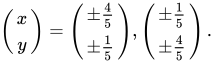
oder umgekehrt. Daher gibt es die acht Lösungen
(
x
y
)
=
(
±
4
5
±
1
5
)
,
(
±
1
5
±
4
5
)
.
{\displaystyle {}{\begin{pmatrix}x\\y\end{pmatrix}}={\begin{pmatrix}\pm {\frac {4}{5}}\\\pm {\frac {1}{5}}\end{pmatrix}},{\begin{pmatrix}\pm {\frac {1}{5}}\\\pm {\frac {4}{5}}\end{pmatrix}}\,.}
Zur gelösten Aufgabe